PC TV Programs – Watch TV Programs on PC
Saturday, 13 August 2011 02:49
This article describes the possibilities of PC TV, which simply means to watch tv on the pc using PC TV programs. Have you encountered a situation like the following before? Great the next match of my favorite sports team will not be shown on free tv. Actually it will not be shown at all in my country, except for satellite of course. If you encounter situations like this one and always thought there would be no other solution than to watch boring live tickers on internet sites, then you have come to the right place that brings you the solution called PC TV.
I will describe three freeware programs that let you connect to channels that stream tv and especially live sports events. This includes all major european football (soccer) leagues, champions league, uefa cup, espn, wrestling, national team matches, boxing matches aso.
You also find regular tv stations like mtv and custom stations like gamers tv there. On with the PC TV programs.
 |
PC TV
All you need to watch pc tv is a computer with the latest windows media player and / or real player. A broadband connection is desired for best results. All three PC TV programs to watch TV on the PC have been produced in Asia making it hard to read the websites. Those websites offer tv program lists among other information.
First, let us take a look at some options in media player and real player:
Start the media player, make sure you use the latest version. Right-Click and select Options from the menu. Click on Performance and Change the Buffer Size of Content to 30 seconds.
In real player you select Tools -> Preferences and click on the General -> Playback Settings. The setting Buffer up to 30 seconds is at the bottom of this window.
mms:// and .asx open with windows media player
rtsp:// and .rm / .ram open with real player
rtsp:// and .rm / .ram open with real player
Starting Streams manually:
Sometimes you need to start streams manually. Use the stream formats information to figure out the program to use.On windows media player choose File -> Open Url or the shortcut ctrl + u
On real player choose File -> Open
PC TV Programs
This is a list of free PC TV programs that can be used to view TV on PC.
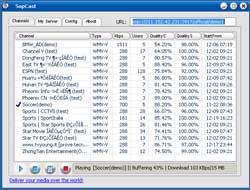
Download from the above link, unzip, start. A channel list will be displayed. Double-click a channel and windows media player should start and begin buffering and displaying.

Just download and run the installation script on pplive. Its all in English, no need to worry. You need the pplive channel list for it, it does not come with a loaded list.

Download from the above location. This one has an installation script that is unfortunately producing lots of gibberish. The buttons are designed like in every other windows installation script. (left button, choose a directory, 3x middle button). The Channel list is on the left, you see the channel name, the quality of the stream in Kb per second and the users connected to the channel.
If I had to choose one of them I?d defiantly choose ppStream which has the best interface and good user rates and a nice overall stream quality.
| channel | content | language |
| CCTV5 | european soccer, other sport events. | Asian ? |
| ESPN | All major us leagues, european soccer + more | English |
| Games Tv (ppstream) | professional game play, tournaments, mags | Asian ? |
| Soccer Demo | soccer | Asian ? |
| Sport Italia | Italian Sports Channel | Italians |
Additional Information:
Using PC TV programs on your computer has never been easier than in today’s Internet. Users can pick a wide variety of applications that bring

Google+ Games [Game Saturday]
02:43
Google enabled Games on my Google+ account while I was sleeping and I thought it would be a nice idea to review what Google+ Games has to offer on Game Saturday. Let me give you a short Google+ introduction before I take a closer look at the games on offer.
Google+ is Google’s attempt to enter the social networking space. It is an invite only system at the moment that concentrates on communication and interaction with other members. Probably the most talked about feature of Google+ is circles, which can be used to group users. This improves the filtering options on Google+ significantly. You can send messages to a specific circle for instance, or look at the news stream of a circle.
There are fundamental differences on the other hand that deserve to be mentioned. Game notifications and invites are for instance only displayed on the games page (in the games stream) and not on the main stream page. This removes the gaming noise from the main news streams.
Google+ Games features 16 different games at this time, of which at least one is a beta game. Games include Angry Birds, City of Wonder or Bejeweled Blitz, which are all available on Facebook as well. Only one game (Flood It) of the 16 available games is not available on Facebook as well.

A click on a game opens an intermediary page that explains that games in Google+ are social, which basically means that contacts may see gaming notifications.
Games launch in a new window and display their privacy policy before they can be played. Google+ users need to accept the privacy policy.
Some games, like Bejeweled Blitz, demand access to your email address, while all that I checked demand access to an ordered list of people from a user’s circles (which interestingly enough is not available to the account owner, the sorted part I mean).

The games do not run in a popup but on the Google+ page directly.

Some games, like Angry Birds, display game scores of your contacts in the game interface (next to beat) which can be both a rewarding but also humiliating experience.

There does not seem to be an option right now to revoke the game permissions again, nor an option to remove high score and other personal information. I would have expected the information to be listed under Profile and privacy, but there is no games (or apps) listing there currently.
Games as of now offer a limited experience, especially since the vast majority of them are also playable on Facebook. The lack of privacy and permission controls on the other hand is serious and needs to be addressed by Google as soon as possible.
I have also received reports that some users have problems playing games at all, for instance when using Chrome Dev versions (game loading freezes).
The inclusion of games moves Google+ from a conversational platform to a more general platform. This could alienate part of the professional tech orientated user base, even though it is easy enough to ignore the games button at the top.
Have you tried Google+ games yet? What is your impression so far?
Update: Google+ users can revoke game permissions on the Authorized Access to your Google Account page.

BitDefender Top 100 Removal Tool
Friday, 5 August 2011 03:08
It’s convenient if you know which malware has made its way on your computer, not so much if you do not know the name or characteristics. The BitDefender Removal Tool has been designed for exactly that reason. It basically combines the top 100 removal tools in one interface. It is by no means an alternative for regular antivirus protection, but a good option if you know that your computer is infected and that your default antivirus solution cannot disinfect the computer.
The Removal Tool is a portable security program for the Windows operating system that has been streamlined for ease of use. There is only one option available in the interface, and that is to start a system scan.

BitDefender’s Removal Tool will start to scan the system for traces of the top 100 viruses, worms, trojans and other malicious software. The scan itself takes some time and it is usually a good option to start it at a time where the PC is idle otherwise.
Malware that is found by the scan is displayed in the interface. BitDefender announced plans to update the Removal Tool monthly to take into account new malware that has made it into the top 100 list of malware of the previous month. For now, only June’s version of the Removal Tool is available. It remains to be seen if the July version will be released anytime soon.
BitDefender’s Removal Tool is available for 32-bit and 64-bit editions of the Windows operating system. Both versions are portable and can be executed directly from any location.
How to Connect Google Calendar to Your Cell Phone
Wednesday, 3 August 2011 03:02
Since you're not always sitting in front of a computer, being able to access your calendar only when you're at a computer isn't all that useful. Imagine that you parked your car in the morning, but you have to move it by 5 p.m. to make way for street cleaning or you'll get a ticket. It's easy to forget to add an item like "Move my car by 5pm" to your calendar if you have to wait until you get to a computer to add it. The solution to this problem: Hook your phone into your calendar.
There are a couple of ways to add Google Calendar to your cell phone, whether you own a cutting-edge smartphone or a bare-bones "dumb" phone.
Sync With Smartphones. If you use an Android phone, this is a no-brainer. Android works seamlessly with GCal; you merely log in to your Google account on your Android device, and it will automatically set up your phone's calendar to sync with GCal. Any events you add from your phone will automatically sync with Google Calendar wirelessly.
If you have an iPhone, BlackBerry, Nokia S60, or Windows Mobile phone, syncing your phone's calendar with GCal is similarly easy when you use the free Google Mobile Sync tool for your particular phone. Head over to the Google Sync page and follow the setup instructions for your device.
Check Your Calendar and Add Events Via SMS.
Don't have a fancy smartphone? No problem. You can still receive event notifications, check your calendar, and even add events to your calendar from any phone that supports SMS messages.
First, head into your GCal settings and associate your cellphone with GCal.
Select Settings, Calendar Settings, Mobile Setup, and follow Google's instructions for validating your phone. Once you validate your phone number, GCal can send you event notifications via e-mail or SMS.
You can even add an SMS reminder as one of your default notification methods, in which case you'll always receive notifications for upcoming events, regardless of where you are, as long as you have your phone on hand.
After you've associated your cell phone's number with your Google Calendar account, you can check your itinerary and create new events by sending text messages to Google Calendar's GVENT (48368) number. Want today's schedule? Just text "day" to GVENT.
Even better: You can create new events by texting GVENT, and it supports the same plain-language input that GCal's Quick Add button does. So if you text GVENT "Move my car at 4:30pm," GCal will translate that into a new event on your calendar. For complete details on GVENT commands, check out this Google Calendar help page.
There are a couple of ways to add Google Calendar to your cell phone, whether you own a cutting-edge smartphone or a bare-bones "dumb" phone.
Sync With Smartphones. If you use an Android phone, this is a no-brainer. Android works seamlessly with GCal; you merely log in to your Google account on your Android device, and it will automatically set up your phone's calendar to sync with GCal. Any events you add from your phone will automatically sync with Google Calendar wirelessly.
If you have an iPhone, BlackBerry, Nokia S60, or Windows Mobile phone, syncing your phone's calendar with GCal is similarly easy when you use the free Google Mobile Sync tool for your particular phone. Head over to the Google Sync page and follow the setup instructions for your device.
Check Your Calendar and Add Events Via SMS.
Don't have a fancy smartphone? No problem. You can still receive event notifications, check your calendar, and even add events to your calendar from any phone that supports SMS messages.
First, head into your GCal settings and associate your cellphone with GCal.
Select Settings, Calendar Settings, Mobile Setup, and follow Google's instructions for validating your phone. Once you validate your phone number, GCal can send you event notifications via e-mail or SMS.
You can even add an SMS reminder as one of your default notification methods, in which case you'll always receive notifications for upcoming events, regardless of where you are, as long as you have your phone on hand.
After you've associated your cell phone's number with your Google Calendar account, you can check your itinerary and create new events by sending text messages to Google Calendar's GVENT (48368) number. Want today's schedule? Just text "day" to GVENT.
Even better: You can create new events by texting GVENT, and it supports the same plain-language input that GCal's Quick Add button does. So if you text GVENT "Move my car at 4:30pm," GCal will translate that into a new event on your calendar. For complete details on GVENT commands, check out this Google Calendar help page.
G+ app for Android driven Mobile Phones
Monday, 1 August 2011 05:11

- Pros
Free. Clean and smart design. Easy to navigate. Easy to learn. Automatically includes a separate app for Huddle (group chat).
- Cons No administrative controls in Huddle. Not all thumbnail images resize and display properly.
- Bottom Line
Social networks need mobile apps to thrive, and Google+'s is a fine start, tapping into conventions established by other online social networks, like Facebook and Twitter, while finding some of its own strengths at the same time.
Do Google services work best when used on Google platforms? I was curious if that would be the case when I installed the a Google+ Mobile app (free) on an Android-based phone (Android being Google's mobile operating system). In fairness, Google's new social network, Google+, runs just as well on Android as it does as an iPhone app (free, 3.5 stars). It doesn't get special treatment on Android, except that when you download and install the app, you actually get two: the primary Google+ app and a separate app for Huddle, or group chat. The only other difference is that the interface on Android deviates slightly from what's in the iPhone app; the way the apps work is largely the same, however.
Mobile apps are essential to the whole social networking experience. Think about Facebook and Twitter. Mobile apps are the most convenient way to check in on what's happening, and just as quickly get back to life in real time. As a social network, Google+ has made itself is much more usable with the addition of the mobile apps.
Part of this success comes from the design. Less screen space (compared with a full computer monitor, where other Google properties are often deployed) means every inch of it has to be use effectively. If you've ever felt that Google was too sparse with its designs on the Web, you might see Google+ as a revelation in Google UI. The app is clean and easy to navigate without too many menus and unnecessary words cluttering the screen.
How to Get Google+ Mobile App
Start by locating the Google+ Mobile app in the Android Marketplace, and dropping it onto your mobile device. Alternatively, you can try getting it through a QR code provided by Google.
Once you find and install the free app, just sign in using your Google account, if it's not already synced to the phone. If it is synced, you can select it from a list after firing up the app. Note that you must already have Google+ access in order to use the app, so if you haven't received an invitation yet, hang tight until you do.
Design
Like Facebook's mobile app, the mobile version of Google+ orients you with a landing screen that shows the main components in a grid, their icons and single-word descriptors helping you choose how you'll use the app. Google+'s icons are not yet as well known as Facebook's, so the names printed below them help a great deal: Stream, Huddle, Photos, Profile, and Circles. If you didn't guess what you can do by the name of the tool, at least you'll be mildly intrigued to dive in and find out.
Features
Any social networking user will be familiar with words like "stream" (updates from your contacts), "profile" (information about you) and "photos." And if you've used the Google+ site, you've likely already established Circles, or subsets of your connections, grouped by whatever classification you want to create, such as close friends, co-workers, extended family, and so forth.
Notably missing in the mobile app is the Hangout feature, or video group chat, which is Web-only. Replacing it is Huddle, a group instant messaging tool. To use Google+'s Huddle, select Huddle and click the speech bubble icon at the top right to start a new chat. Alternatively in Android, you can go directly to the Huddle app that automatically installs when you first downloaded the Google+ mobile app. In Huddle, you can invite individuals to group chat with you or an entire Circle. As people are invited, their profile pictures appear in a strip at the top, giving you the ability to quickly see who's there. Six images fit easily in that banner at the top, and when more people are invited, the strip become scrollable. This visual presentation of who has been invited to a Huddle is excellent.
Apple, Android Battling for Smartphone Leadership in Mobile OS Race
Sunday, 31 July 2011 05:47
The mobile phone market is changing. Depending on how you slice that market, the biggest winner in the last year was either Apple or Google. Apple is the largest maker of smartphone handsets, but Google’s Android smartphone OS is the top seller while Apple’s iOS is No. 2.
But for the top handset market share, it’s still Nokia, due mostly to its vast number of non-smartphone sales. However, Nokia’s smartphone sales are off while the company sells units with its aged Symbian operating system and waits for Microsoft Phone 7 equipped devices to appear in large numbers.
Apple enjoyed explosive growth in smartphone sales over last year, with an increase of 141.8 percent, according to an IDC report. Nokia, while still tops in overall phone market share suffered a drop in sales of more than 20 percent.
But there’s more to the smartphone market than who makes the handset. According to a Nielsen survey, Android-based phones now own 39 percent of the U.S. market compared to Apple’s 28 percent. The reason for the difference, of course, is there are multiple handset makers supporting the Android OS, while there’s only one Apple–supporting iOS.
Meanwhile, there are any number of rumors that could change the dynamic significantly, depending on what turns out to be true. For example, there’s a rumor that Apple could offer the iPhone to all U.S. carriers instead of just AT&T and Verizon Wireless. If that were to happen, perhaps there’s a chance that Apple could surge ahead of the Android devices by opening up availability. There’s certainly demand–one source at T-Mobile told me that there are about a million iPhone users on T-Mobile now–enough that T-Mobile stores are selling some iPhone accessories.
The level of hype surrounding the iPhone, especially the long anticipated iPhone 5 will also help build market share for both the device and for iOS. According to a PriceGrabber survey, 35 percent of consumers say they will buy an iPhone 5 when it comes out. If these numbers pan out (and that’s not a sure thing) then that could bump the iPhone into top place in the United States and perhaps globally in the smartphone market.
But for the top handset market share, it’s still Nokia, due mostly to its vast number of non-smartphone sales. However, Nokia’s smartphone sales are off while the company sells units with its aged Symbian operating system and waits for Microsoft Phone 7 equipped devices to appear in large numbers.
Apple enjoyed explosive growth in smartphone sales over last year, with an increase of 141.8 percent, according to an IDC report. Nokia, while still tops in overall phone market share suffered a drop in sales of more than 20 percent.
But there’s more to the smartphone market than who makes the handset. According to a Nielsen survey, Android-based phones now own 39 percent of the U.S. market compared to Apple’s 28 percent. The reason for the difference, of course, is there are multiple handset makers supporting the Android OS, while there’s only one Apple–supporting iOS.
Meanwhile, there are any number of rumors that could change the dynamic significantly, depending on what turns out to be true. For example, there’s a rumor that Apple could offer the iPhone to all U.S. carriers instead of just AT&T and Verizon Wireless. If that were to happen, perhaps there’s a chance that Apple could surge ahead of the Android devices by opening up availability. There’s certainly demand–one source at T-Mobile told me that there are about a million iPhone users on T-Mobile now–enough that T-Mobile stores are selling some iPhone accessories.
The level of hype surrounding the iPhone, especially the long anticipated iPhone 5 will also help build market share for both the device and for iOS. According to a PriceGrabber survey, 35 percent of consumers say they will buy an iPhone 5 when it comes out. If these numbers pan out (and that’s not a sure thing) then that could bump the iPhone into top place in the United States and perhaps globally in the smartphone market.
Windows Phone “Mango” – Released to Manufacturing
Tuesday, 26 July 2011 05:25
by Terry Myerson
I wanted to drop into the Windows Phone Blog briefly to update you on an important milestone. Earlier this morning, the Windows Phone development team officially signed off on the release to manufacturing (RTM) build of “Mango” – the latest version of the Windows Phone operating system. This marks the point in the development process where we hand code to our handset and mobile operator partners to optimize Mango for their specific phone and network configurations. Here on the Windows Phone team, we now turn to preparing for the update process. The Mango update for current Windows Phone handsets will be ready this fall, and of course will come pre-installed on new Windows Phones.
In May, we officially took the wraps off of Mango, a release including hundreds of new features that create a smarter and easier approach to communications and apps, while delivering the best web experience. My favorites?
· Our unique new email Conversation View which helps me to efficiently participate in long email discussions with my friends and co-workers.
· Threads that bring together my text, IM, and Facebook chat all into one conversation.
· App Multitasking, enabling me to efficiently work on my email, listen to music, and then pop in and out of Words By Post games when it is my turn. Mango also connects apps to search results and deepens integration within the Hubs like Music and Video and Pictures.
· Internet Explorer 9 for fast web browsing and support for new HTML 5 web sites.
We can’t wait to get Mango in your hands so you can experience all the new features for yourself and give us feedback on where to go next. As we reach additional milestones we will be back to share more but until then, thank you for your support of Windows Phone.
[source: WindowsPhone Blog ]
I wanted to drop into the Windows Phone Blog briefly to update you on an important milestone. Earlier this morning, the Windows Phone development team officially signed off on the release to manufacturing (RTM) build of “Mango” – the latest version of the Windows Phone operating system. This marks the point in the development process where we hand code to our handset and mobile operator partners to optimize Mango for their specific phone and network configurations. Here on the Windows Phone team, we now turn to preparing for the update process. The Mango update for current Windows Phone handsets will be ready this fall, and of course will come pre-installed on new Windows Phones.
In May, we officially took the wraps off of Mango, a release including hundreds of new features that create a smarter and easier approach to communications and apps, while delivering the best web experience. My favorites?
· Our unique new email Conversation View which helps me to efficiently participate in long email discussions with my friends and co-workers.
· Threads that bring together my text, IM, and Facebook chat all into one conversation.
· App Multitasking, enabling me to efficiently work on my email, listen to music, and then pop in and out of Words By Post games when it is my turn. Mango also connects apps to search results and deepens integration within the Hubs like Music and Video and Pictures.
· Internet Explorer 9 for fast web browsing and support for new HTML 5 web sites.
We can’t wait to get Mango in your hands so you can experience all the new features for yourself and give us feedback on where to go next. As we reach additional milestones we will be back to share more but until then, thank you for your support of Windows Phone.
[source: WindowsPhone Blog ]
Android is the top Mobile OS
Friday, 22 July 2011 05:12
Google's Android mobile operating system was the most popular choice among smartphone buyers in June, but Apple's iOS helped Cupertino become the top smartphone manufacturer in the U.S. last month, according to Thursday data from Nielsen.
Android now has the largest share of the U.S. smartphone market with 39 percent, followed by Apple and iOS with 28 percent. Research in Motion's BlackBerry, meanwhile, is down to 20 percent.
"Because Apple is the only company manufacturing smartphones with the iOS operating system, it is clearly the top smartphone manufacturer in the United States," Nielsen wrote in a blog post.
HTC, Motorola, and Samsung also had a pretty successful month. HTC's Android phones represented 14 percent of the smartphone market, while its Windows Mobile/Phone 7 devices nabbed 6 percent. Android-based Motorola smartphones, meanwhile, made up 11 percent of U.S. smartphones last month, while 8 percent of smartphone owners had a Samsung Android device. Samsung also sold about 2 percent of Windows Mobile and Windows Phone devices.
Earlier this month, comScore said that Samsung was the top U.S. handset manufacturer between March and May with 24.8 percent of the market, while Android nabbed 38.1 percent of smartphone OS market share.
Controversial June numbers from IDC, meanwhile, said that Android and Windows Phone would be the top two mobile operating systems by 2015. That might not be too far-fetched for Android at this point, but Windows Phone has thus far had a slow start. That could change, however, when Nokia starts releasing Windows Phone-based devices later this year.
Android now has the largest share of the U.S. smartphone market with 39 percent, followed by Apple and iOS with 28 percent. Research in Motion's BlackBerry, meanwhile, is down to 20 percent.
"Because Apple is the only company manufacturing smartphones with the iOS operating system, it is clearly the top smartphone manufacturer in the United States," Nielsen wrote in a blog post.
HTC, Motorola, and Samsung also had a pretty successful month. HTC's Android phones represented 14 percent of the smartphone market, while its Windows Mobile/Phone 7 devices nabbed 6 percent. Android-based Motorola smartphones, meanwhile, made up 11 percent of U.S. smartphones last month, while 8 percent of smartphone owners had a Samsung Android device. Samsung also sold about 2 percent of Windows Mobile and Windows Phone devices.
Earlier this month, comScore said that Samsung was the top U.S. handset manufacturer between March and May with 24.8 percent of the market, while Android nabbed 38.1 percent of smartphone OS market share.
Controversial June numbers from IDC, meanwhile, said that Android and Windows Phone would be the top two mobile operating systems by 2015. That might not be too far-fetched for Android at this point, but Windows Phone has thus far had a slow start. That could change, however, when Nokia starts releasing Windows Phone-based devices later this year.
Nokia 6303i
Friday, 8 July 2011 05:16

In a word or two
The Nokia 6303i Classic is a compact mobile phone with an even more compact price.
The Design
The Nokia 6303i Classic is a tweaked version of the popular Nokia 6303 Classic. The phone has some internal upgrades and comes in two extra case colours – white on silver and khaki on gold – but the “i” version is the same size and weight (a mere 96g) as the original. This means the 6303i is pocket-friendly, with a traditional Nokia look.
Candybar in shape, the Nokia 6303i Classic has is an attractive layout which appeals to both the eye and the fingers thanks to the spacing of each key. The 2.2 inch screen displays a good resolution and supports 16 million colours – which is particularly good given the greater social networking integration of this Nokia.
Nokia 6303i Classic Specifications
Communication is straightforward on the Nokia 6303i Classic. The phone packs a number of options into its slim case including Bluetooth and Ovi Services. You can download applications onto your phone via the Ovi Store as well as quickly share your snaps using the Ovi Share function. And with a 3.2-megapixel camera onboard, you will probably want to share your images with friends. The camera has autofocus, 4x digital zoom and a dual LED flash. With a video option, you can happily capture still and live footage on your travels, and although the quality is not the finest it is sufficient to certainly enjoy this feature.
Another good tweak of the Nokia 6303i Classic is its ability to support instant messaging. As well as chatting via social networking sites, you can engage in real-time conversations online – and there are the usual communication options on top like email, and text and multimedia messages.
The battery life has also been enhanced compared to the original 6303. The Nokia 6303i Classic has an incredible 515 hours standby time, which makes a refreshing change to the likes of the iPhone and Google Nexus One smartphones which seem to devour batteries in a matter of hours. With the Nokia 6303i Classic, you can go away for the weekend and not panic if you forget your phone charger. This battery is also great when it comes to enjoying your music as it supports up to 30 hours of music playback from a single charge. You can choose to listen to your own playlists or tune into your preferred FM radio station, and listen via the 3.5mm audio connector or through the phone’s internal speakers.
Considerations
The Nokia 6303i Classic is a 2G mobile with no support for 3G or Wi-Fi.
Nokia 5220
Friday, 1 July 2011 05:14

The relatively new Nokia 5220 is one of the Xpress Music phones from Nokia which offers a good set of features including a very good music player and a 3.5mm head phone jack. The phone has a great look to it as well and is very easy to use. It’s essentially a cheap phone which offers a good set of features and the added bonus of being a dedicated music phone. There is a dedicated audio chip inside the phone which helps music quality through headphones. So far, we’ve not seen much wrong with this phone at all and would highly recommend it to personal users who enjoy music.
Specifications
The Nokia 5220 is a music phone so as you’ve probably guessed it is equipped with a great media player so you can listen to music whenever you feel like it. The phone has about 30 MB of internal memory which isn’t very much for music (about 5 songs) but it can be expanded up to 2GB which is enough for about 500 songs so it’s definitely worth getting a memory card for this phone. The phone also has a 3.5 mm headphone jack which is very helpful because it means you can plug in your own headset and listen to music whenever you please.
The Nokia 5220 also has a 2 mega pixel camera which comes in handy for snapping a few shots here and there. The camera has a 4 x digital zoom and is relatively good considering the price range this phone is in. The camera can also record video clips which is handy although the quality isn’t excellent so if you need something better than average you should look elsewhere. The phone has a lot of features for a device in this price range and is also equipped with FM radio with RDS which means you can tune into your favorite radio station when you’re out and about.
The phone also has a good organizer with a calendar and memos. You can also use the voice memo and built in hands free as and when you need it. There is also a good battery on board this phone which lasts up to 24 hours for music playback. The phone’s standby time and talk time is 406 hours and 5 hours respectively which is pretty good for a phone of this style. All in all, the features of this phone are good and we’d definitely recommend it to basic personal users who enjoy music features.
Looks
The Nokia 5220 has a rather funky design on the exterior which is asymmetrically designed to make it easy and comfortable to hold. However, it is a bit odd so it might not be everyone’s cup of tea so beware of this. However, practically it is a very good handset and appears to have a good range of usability. The handset itself is available in three colours; blue, red and green and we always like a handset that is available in more than one colour because it gives users a chance to be unique. The phone measures in at about 108mm by 43.5mm by 10.5mm so isn’t huge by any means and is actually quite slim line in design.
The phone weighs about 78 grams which is very light for a music phone and we think this is great because it’s lightweight, slim line and stylish. In our opinion, the phone has a nice and stylish design to it and is probably going to be very popular with personal users because it’s funky and stylish and is definitely a personal phone in terms of its design, look and feel. However, it won’t be everyone’s cup of tea because it is an odd shape – some people will find it to be cool, others will find it to be odd.
Design
In terms of design, the Nokia 5220 has good software and the user interface and operating system appear to run smoothly together. There have been some comments about the phone randomly switching itself off during calls but this doesn’t appear to be a widespread problem. Overall, the design of the software is good and seems to match the internal applications and features well. It appears to be easy to use and most of the applications run quickly and you should be able to use this phone easily and perform tasks quickly and with little or no trouble at all.
Overall
All in all, the Nokia 5220 is a good looking phone and although it won’t be everyone’s cup of tea it’ll probably be very popular because it’s different. The features inside the phone are very good and the design of the exterior is also good in terms of usability. The phone’s camera and video recording facilities may not be the best but they offer an easy and fast way to snap a few shots and are both perfect for basic personal users. We’d definitely recommend this phone to personal users who enjoy music features because the phone has a dedicated set of features just for enjoyment of music.
Also, the Nokia 5220 has a nice look to it and is very stylish inside and out and as it is only £130 on PAYG and free on contract you can probably get a pretty good deal on this phone which will make it all the more popular. For a mid range phone it certainly has a good amount of features which will make personal users very excited and we think it’s a great phone that is definitely worth the purchase. It has all you could need as well as being in a stylish handset which is different and unique.
Overall, the Nokia 5220 is definitely a phone we’d recommend to personal users and it seems to have a nice set of high quality features which make it a very popular handset to own. The only downside is the problem with the phone shutting off randomly but as this doesn’t appear to be a widespread problem we think it’s safe to say that it’s a good phone with good features and will probably make a lot of people very happy to own. All in all, the Nokia 5220 is yet another good phone from Nokia.
F-Secure Anti-Theft For Mobile
Thursday, 23 June 2011 03:05
A lost or stolen cell phone can be devastating, considering that the phone may contain private data and information that may even be used for identity theft or other criminal activities.
F-Secure Anti-Theft For Mobile is a free security software for cell phones running Symbian OS, Windows Mobile or Android. It offers several options to take control of the situation.
The key features of Anti-Theft for Mobile are the ability to remotely lock the cell phone, locate it and to wipe its data in case it looks like the phone is lost forever.

The software reacts on remote commands send via SMS to the phone. Here are the available commands and their action:
- Send #lock#YourCode to the stolen or lost phone. Will lock the phone, only option to unlock it is to enter the correct password.
- Send #locate#YourCode to the phone. Locates the phone and displays a link to Google Maps that can be used to find out where the phone is located.
- Send #wipe#YourCode to the phone to delete all confidential data on the phone.
Windows 8: Microsoft's Radical Move
Wednesday, 15 June 2011 05:28
Microsoft decided to whip back the curtain on Windows 8, with demonstrations at the 2011 Computex conference in Taiwan and D:All Things Digital Conference in Rancho Palos Verdes, Calif.
If things stay on course through the final release, Microsoft's next-generation operating system will represent something of a sea change from previous versions of Windows. At least in the tablet version demonstrated at both conferences, Windows 8's user interface relies on large, colorful tiles that display active information and open applications at a finger-touch. ("Windows 8," by the way, is apparently Microsoft's internal codename for the OS, and not necessarily the moniker for the final version.)
Windows 8 features multitasking, including the ability to display two apps side-by-side on the screen. Users can "snap" applications to one side of the screen, a feature heavily reminiscent of the "Aero Snap" present in Windows Vista and Windows 7. A swipe of the finger will cycle through apps. There's a virtual keyboard, adjustable Interface aside, Windows 8 will apparently support the full version of legacy applications such as Office.
"This represents a fundamental shift in Windows design that we haven't attempted since the days of Windows 95, presenting huge opportunities for our hardware partners to innovate with new PC designs," Mike Angiulo, corporate vice president of Windows Planning, Hardware and PC Ecosystem, reportedly told the audience at the Computex conference.
Windows 8 on a tablet certainly looks pretty. The question is whether that streamlined, sleek interface can support the heavy-duty needs of hardcore PC users, who are used to the old Windows interface that allows for multiple open windows and documents and applications. Microsoft has shown how Windows 8 can play, particularly on a tablet; the question now is how Windows 8 can improve people's daily workflow--not to mention, how seamlessly it can reconcile this new interface and apps with the legacy baggage that so many users and developers bring to the proverbial table.
[source: Microsoft Watch ]
If things stay on course through the final release, Microsoft's next-generation operating system will represent something of a sea change from previous versions of Windows. At least in the tablet version demonstrated at both conferences, Windows 8's user interface relies on large, colorful tiles that display active information and open applications at a finger-touch. ("Windows 8," by the way, is apparently Microsoft's internal codename for the OS, and not necessarily the moniker for the final version.)
Windows 8 features multitasking, including the ability to display two apps side-by-side on the screen. Users can "snap" applications to one side of the screen, a feature heavily reminiscent of the "Aero Snap" present in Windows Vista and Windows 7. A swipe of the finger will cycle through apps. There's a virtual keyboard, adjustable Interface aside, Windows 8 will apparently support the full version of legacy applications such as Office.
"This represents a fundamental shift in Windows design that we haven't attempted since the days of Windows 95, presenting huge opportunities for our hardware partners to innovate with new PC designs," Mike Angiulo, corporate vice president of Windows Planning, Hardware and PC Ecosystem, reportedly told the audience at the Computex conference.
Windows 8 on a tablet certainly looks pretty. The question is whether that streamlined, sleek interface can support the heavy-duty needs of hardcore PC users, who are used to the old Windows interface that allows for multiple open windows and documents and applications. Microsoft has shown how Windows 8 can play, particularly on a tablet; the question now is how Windows 8 can improve people's daily workflow--not to mention, how seamlessly it can reconcile this new interface and apps with the legacy baggage that so many users and developers bring to the proverbial table.
[source: Microsoft Watch ]
Intel Core 2 Duo E6700 Review
Saturday, 7 May 2011 22:47

The good: Most cost-efficient chip on the market; low power consumption makes it cooler, quieter, and easy to use in smaller PC designs.
The bad: Chipset politics between Intel and graphics card vendors hurt gamers, who now have to pick an Intel board for ATI's CrossFire or an Nvidia board for SLI cards.
The bottom line: Intel's Core 2 Duo E6700 offers the best price-to-performance ratio we've seen in a desktop chip. For half the cost of AMD's top-of-the-line chip, you get identical if not superior performance and better power efficiency. AMD surprised us last year with its completely dominant dual-core chips, but Intel regains the crown with Core 2 Duo.
Review: AMD, you've had a good run.
Intel announced its line of Core 2 Duo desktop CPUs today. If you're buying a new computer or building one of your own, you would be wise to see that it has one of Intel's new dual-core chips in it. The Core 2 Duo chips are not only the fastest desktop chips on the market, but also the most cost effective and among the most power efficient. About the only people these new chips aren't good for are the folks at AMD, who can claim the desktop CPU crown no
... Expand full review
AMD, you've had a good run.
Intel announced its line of Core 2 Duo desktop CPUs today. If you're buying a new computer or building one of your own, you would be wise to see that it has one of Intel's new dual-core chips in it. The Core 2 Duo chips are not only the fastest desktop chips on the market, but also the most cost effective and among the most power efficient. About the only people these new chips aren't good for are the folks at AMD, who can claim the desktop CPU crown no longer.
We've given the full review treatment to two of the five Core 2 Duo chips. You can read about the flagship $999 Core 2 Extreme X6800 here and the entire Core 2 Duo series here. In this review, we examine the next chip down, the $530 2.67GHz Core 2 Duo E6700. While the Extreme X6800 chip might be the fastest in the new lineup, we find the E6700 the most compelling for its price-performance ratio. For just about half the cost of AMD's flagship, the $1,031 Athlon 64 FX-62, the Core 2 Duo E6700 gives you nearly identical, if not faster performance, depending on the application.
As we outlined in a blog post a month ago, the Core 2 Duo represents a new era for Intel. It's the first desktop chip family that doesn't use the NetBurst architecture, which has been the template for every design since the Pentium 4. Instead, the Core 2 Duo uses what's called the Core architecture (not to be confused with Intel's Core Duo and Core Solo laptop chips, released this past January). The advances in the Core architecture explain why even though the Core 2 Duo chips have lower clock speeds, they're faster than the older dual-core Pentium D 900 series chips. The Core 2 Extreme X6800 chip, the Core 2 Duo E6700, and the $316 Core 2 E6600 represent the top tier of Intel's new line, and in addition to the broader Core architecture similarities, they all have 4MB of unified L2 cache. The lower end of the Core 2 Duo line, composed of the $224 E6400 and the $183 E6300, have a 2MB unified L2 cache.
We won't belabor each point here, since the blog post already spells them out, but the key is that it's not simply one feature that gives the Core 2 Duo chips their strength, but rather it's a host of design improvements across the chip and the way it transports data that improves performance. And out test results bear this out.
On our gaming, Microsoft Office, and Adobe Photoshop tests, the E6700 was second only to the Extreme X6800 chip. Compared to the 2.6GHz Athlon 64 FX-62, the E6700 was a full 60 frames per second faster on Half-Life 2, it finished our Microsoft Office test 20 seconds ahead, and it won on the Photoshop test by 39 seconds. On our iTunes and multitasking tests, the E6700 trailed the FX-62 by only 2 and 3 seconds, respectively. In other words, with the Core 2 Duo E6700 in your system, you'll play games more smoothly, get work done faster, and in general enjoy a better computing experience than with the best from AMD--and for less dough.
MWC 2011: LG overview
22:41
Press conference
The LG press conference at the start of MWC 2011 saw the official announcement of the Optimus 3D and Optimus Black smartphones and the 8.9" tablet Optimus Tab.


MWC booth
Of course we also stopped by the LG booth at the MWC itself, where we could spend some more quality time with the new devices.


As you can see from the photos the new announcements generated quite a lot of interest. Still we managed to fight our way through the crowd and got our geeky hands on all of them.
Understandably, we started with the Optimus 3D. Join us after the break for a load of live images, a hands-on video and a real 3D video captured with its cameras. Plus we've got its impressive Quadrant benchmark performance.
Samsung Galaxy S II vs LG Optimus 2X
22:39
Introduction
Ah, the power of dual-core processors – it lets you do cool stuff like buttery-smooth multitasking, exciting 3D portable gaming or Full HD videos. The latest Samsung I9100 Galaxy S II packs the new Exynos chipset, which pairs a couple of Cortex-A9 cores with a Mali-400MP GPU. Sounds like a potent mix – at least on paper, so we’re eager to pit it against one of the first phones to offer Nvidia’s Tegra 2 platform - the LG Optimus 2X.


What we have in our hands is a pre-release test unit of the Galaxy S II, successor to one of the best selling Android phones. Ours runs its two CPU cores at 1GHz but Samsung announced that the speed will be bumped up to 1.2GHz.
Once that’s done, the I9100 Galaxy S II would be the most powerful droid – until the competition catches up, which won’t take long judging by our rumor mill. Anyway, we’re going to use the chance to put Samsung’s Exynos chipset head to head with NVIDIA’s Tegra 2. We’ll be using the LG Optimus 2X for the benchmarks, which runs at the same clock speed as our Galaxy S II – 1GHz.
We’re already working on our Galaxy S II preview but until that’s done, we just couldn’t resist testing some of the most interesting new features of Samsung’s latest flagship. Here’s what this comparison will be about.
First off, this is our first encounter with the Super AMOLED Plus technology, which improves on an already excellent screen. We’ll run the new display through several tests to determine how it stacks up against the old one and other leading displays on the market.
Next, we’ll get to the camera department – the Galaxy S II comes with an 8MP still shooter that can capture 1080p FullHD videos. That’s our second encounter with such a beast and we’ll be pitting it against the LG Optimus 2X camera, that’s for sure. A surprising guest star in the camera test is the Sony Ericsson Arc, which we recently reviewed as well.
After that comes the test of what makes the Samsung I9100 Galaxy S II tick – the new dual-core Exynos chipset. Just keep in mind the Galaxy S II retail version will have 20% more clock speed for each of the two CPU cores.
Finally, we’ll wrap things up with a real-life performance test – how does the Galaxy S II stack up in real world tasks (we’ll be testing the user interface, web browser and games) against a phone with a Tegra 2 chipset (which is quite popular among new smartphones and even tablets).


Ready? Then let’s jump to the next page – but be warned, you are in for some serious display envy.
Motorola Atrix 4G review: Enter the Atrix
22:35
Introduction
It was the alliance with Android that put Motorola out of the woods. Like every partnership, it’s been a series of peaks and dips but every now and then the relationship between Motorola and Android goes beyond a mere marriage of convenience and well into a simmering love affair.They did it with the MILESTONEs and the DROID X, the BACKFLIP and the DEFY. With the ATRIX 4G, Moto says it has no plans to live in the shadows of other big makers.


Motorola ATRIX 4G official photos
The Motorola ATRIX 4G is the first dual-core smartphone in the Motorola line-up. It’s also the first to flaunt a qHD touchscreen. That’s as solid as credentials get. Add the fact it’s the first handset for Motorola to support the fast HSDPA+ network (hence the 4G moniker) and you’ve got yourself a Droid that’s not afraid of what comes next.
Dual core is certainly the next big thing in mobile phones and the Motorola ATRIX deserves credit for being among the first – our bad really, this review isn’t exactly on time.
But there are other bold decisions that Motorola had to make. The HD and laptop docks for one – though the concept is not exactly original, Motorola is trying to make it mainstream. The added fingerprint scanner is not new either but well forgotten old does just as well. Plus, it will satisfy the privacy freak in all of us.
Anyway, the standard package is what we’re interested in and this is what our review will focus on. The optional extras can wait. The ATRIX is more important to us a phone (a dual-core smartphone, to be precise) than a wannabe laptop or a potential entertainment dock. Let’s waste no more time and take a glimpse of the ATRIX 4G’s key features.
Key features
- Quad-band GSM and dual-band 3G with HSDPA and HSUPA
- 4" 16M-color capacitive touchscreen of qHD (960 x 540 pixels) resolution, scratch-resistant Gorilla glass
- Dual-core 1GHz ARM Cortex-A9 proccessor, ULP GeForce GPU, Tegra 2 chipset; 1GB of RAM
- Android OS v2.2; MOTOBLUR UI (update to Gingerbread planned)
- Web browser with Adobe Flash 10.1 support
- 5 MP autofocus camera with dual-LED flash; face detection, geotagging
- 720p video recording @ 30fps (to be upgraded to 1080p Full-HD )
- Wi-Fi ab/g/n; Wi-Fi hotspot functionality; DLNA
- GPS with A-GPS; Digital compass
- Fingerprint scanner that doubles as a power key
- 16GB storage; expandable via a microSD slot
- Accelerometer and proximity sensor
- Standard 3.5 mm audio jack
- microUSB port (charging) and stereo Bluetooth v2.1 with A2DP
- standard microHDMI port
- Smart and voice dialing
- Office document editor
- Active noise cancellation with a dedicated secondary mic
- DivX/XviD video support
- Lapdock and HD Dock versatility
- Web browser with Adobe Flash 10.2 support
Main disadvantages
- Not the latest Android version
- No FM radio
- Screen image is pixelated upon closer inspection
- Questionable placement of the Power/Lock button
- Poor pinch zoom implementation in the gallery
- No dedicated shutter key
- Doesn’t operate without a SIM card inside


Motorola ATRIX 4G live photos
Garnish all this premium hardware with a 5MP camera with dual LED flash and a 4-inch capacitive touchscreen of qHD resolution of 540x960 pixels, and the ATRIX 4G is more than ready to play with the other dual-core kids.
As for us, we are about to take a closer look at the design and build of the phone and find out if it matches the premium hardware that resides within.
HTC Desire S review: Droid cravings
22:33
Introduction
Powerful hardware, large high-res screen and the latest Android version in a single piece of solid metal – the recipe did wonders for the original Desire so no wonder HTC are in no mood to experiment with the sequel. Take the best and make it better pretty much sums up the game plan. Oh well, we’ll take quietly brilliant even if emphasis is sometimes on quiet. In other words, the Desire S is a phone we’re ready to like. But make no mistake – it’s not meant to be the flagship its predecessor was.

HTC Desire S official photos
HTC has the Sensation to send against the heavyweight competition. The new Desire is given a different, though no less important role. Ideally, it should be the smartphone that has broader appeal, the one to offer as reward to loyal upgraders. The phone to give you – wait for it – more bang for your buck than we’ve come expect from HTC.
Here’s what it puts on the table summarized.
Key features
- Quad-band GSM and dual-band 3G support
- 14.4 Mbps HSDPA and 5.76 Mbps HSUPA
- 3.7" 16M-color capacitive LCD touchscreen of WVGA resolution (480 x 800 pixels)
- Uses the best screen from HTC so far (along with the Incredible S)
- Android OS v2.3 Gingerbread with HTC Sense
- 1 GHz Scorpion CPU, Adreno 205 GPU, Qualcomm Snapdragon MSM8255 chipset
- 768 MB RAM and 1.1 GB ROM
- 5 MP autofocus camera with LED flash and geotagging
- 720p video recording @ 30fps
- Wi-Fi b/g/n and DLNA
- GPS with A-GPS
- microSD slot up to 32GB (8GB card included)
- Accelerometer and proximity sensor
- Standard 3.5 mm audio jack
- Stereo FM radio with RDS
- microUSB port (charging) and stereo Bluetooth v2.1
- Smart dialing, voice dialing
- Front facing camera, video calls
- DivX/XviD video support
- Compact aluminum unibody
- Gorilla glass display
- HTC Locations app
- HTCSense.com integration
- HTC Portable Hotspot
- Ultra-fast boot times (if you don’t remove battery)
Main disadvantages
- No dedicated camera key and no lens cover
- Poor camcorder performance, jerky 720p videos
- Below-par sunlight legibility
- Wi-Fi signal degrades when you cover the top part of the back panel
- microSD is below the battery cover
Video-chat enthusiasts will cheer the front-facing camera, while those who want lots of apps installed on their smartphones will appreciate the extended built-in memory.


The HTC Desire S at ours
The bad news is the Desire S is – in more than one way – running against the clock. A year is a really long time in cell phone terms and there’s no guarantee the updates are enough to make it competitive in a market that’s embracing dual-core and pushing beyond the 1GHz mark.
The easiest way to dispel the doubts would be to sail smooth through this review. So why wait – unboxing coming up right after the break.
Nvidia GeForce GTX 580
10:00
In early 2010 Nvidia released their GTX 400 series of graphics cards for the hardcore gamers out there. However, just six months later they released the Nvidia GeForce GTX 580, the first model in the 500 series and the new flagship graphics card for this outstanding company. Much like the 480, this model uses DirectX 11 and has a single GPU. Most of the primary features that affect the 3D rendering and speed were updated to meet today's standards and the reality is that the GTX 580 is one of the fastest and best-performing graphics cards on the market. Because of this it received our TopTenREVIEWS Gold Award for overall power and performance.
GPU/Interface: 
Nvidia chose to stay with the single GPU for the GTX 580, which is by no means a bad choice; they have been making this type of video card for years and know exactly what they are doing. This is by far the most powerful single-GPU card on the market when it comes to overall power output and benchmark tests. If you compare this card to that of the older 480 model you will notice that the specs are slightly higher across the board and that the power needed to run the card is slightly less than most of the competition. The transistor count was upped ever so slightly from their previous model and still outnumbers that of any card on the market.
Video Memory:
When it comes to finding a graphics card that will be able to play any game at top performance it's important to look at the clocked memory and overall memory. The Nvidia GTX 580 has the highest clocked memory speed we've seen – 2004 MHz – which even outperforms any dual-GPU cards on the market today. You are going to love the 1.5GB of memory because this will ease the amount of RAM needed to render the intense graphics of games like "COD: Black Ops" and other graphics-intensive games.
The memory in this graphics card is GDDR5, which is the new standard for any card that wants to compete with other high-end gaming hardware. The memory bus width did not change from the 480 model and stayed at 384-bits, which should still do just fine compared to most graphics cards on the market today. An amazing 192.4 bandwidth was added which comes very close to dual-GPU cards.Display Interface:
The Nvidia GTX 580 is like most other graphics cards from Nvidia and simply offers the connections that are most common. In this case they offer dual-channel DVI, Mini-HDMI 1.3 and also support VGA. Dual-channel DVI is by far the most common connection type and pretty much makes up for the omission of an HDMI connection. This card has the type of connections that are in demand and not a lot of extra ones which can be nice if you don’t know a lot about graphics cards and want to install your own.
Supported API:
With the release of Windows 7 also came the very important DirectX 11 update to graphics cards. Nvidia's first card to offer this DX 11 was the 480, so it was no surprise to see their replacement model with the same technology. The reality is that both of these cards use Fermi architecture based on CUDA and also use DirectX 11 for superior tessellation, which has always been one of Nvidia's strongest areas and will most likely stay that way.
Rendering Technologies:
The Nvidia GTX 580 graphics card is the second series of models to use what Nvidia likes to call Fermi; this is basically what CUDA was but with greater potential. CUDA allowed for higher performance, a wider array of applications to run at once, full-spectrum computing and just about anything else in terms of computing power. Now take that and add in the capability to work with everything DirectX demands and you have the new and improved Fermi. This technology is designed to aid developers, allowing them to create even better games for all of us to enjoy.
One of the main areas that Nvidia focuses on with their graphics cards is tessellation. This technology basically allows complex, intricate images such as clothing, water and fire to render faster. Things that have a lot of moving parts such as hair or grass are much harder to render because there are thousands or even millions of objects that have to move according the wind or the movement of an object. Tessellation makes it possible for each blade of grass or flame in a fire to act like it would if you were to see it in real life. This technology is always improving and will always be a huge since games will continue to become more lifelike and even more detailed.The ability to run multiple screens at the same time is another thing that most gamers and game developers need. This graphics card only allows for three displays which is enough for most gamers out there but will fall short for those developing the games of the future.
Additional Features:
All Nvidia cards can support up to 3 GPUs at the same time and for the most part this is about all you would ever need for any system. The graphics card itself is cooled by a fan and is also cooled by the fans or liquid cooling system installed into your machine; the combination should have no problem keeping this card at a reasonable temperature. The card is quite thick at 4.4 inches high which will take up 2 slots of most mother boards; keep this in mind if you are planning on adding two cards to your system.
Summary:
When push comes to shove, the Nvidia GeForce GTX 580 is going to beat out just about every other graphics card. In terms of tessellation, there is no graphics card on the market that can outdo the GTX 580. We would love to see Nvidia add a dual-GPU card to their lineup, but we're more than confident that this card will impress any gamer out there. Now if you want to really destroy the competition you can link two 580s together with Nvidia's own SLI multi-GPU solution; that would outperform anything on the market without even breaking a cyber-sweat.
Pros: The updated memory clock speed and use of Fermi technology make this card exceptional.
Cons: It only has a single GPU.
The Verdict: The fastest single GPU on the market hands down.
Screenshots:


Subscribe to:
Posts (Atom)